Japanese Horse Names: 100+ Authentic Names With Meaning
Quick Takeaways
Most horse naming guides never go near Japanese. That leaves you doing your own research, running into kanji you cannot read, and eventually landing on “Sakura” because it was the only word that came up in plain English. If you wanted a name with real cultural depth behind it and a sound that holds up in a busy barn, that search deserves better than cherry blossoms and a dead end.
Japan has a horse culture most Western riders know almost nothing about. The Kiso horse, one of Japan’s eight indigenous breeds, has been documented since the 8th century. Horses appear throughout the Man’yoshu, Japan’s oldest poetry anthology compiled around 759 AD.
Samurai horsemanship, called bajutsu, shaped Japanese horse culture for over 700 years before Western riding traditions arrived. And Japanese horse racing today operates at a scale most people find genuinely surprising: the Japan Racing Association handles more wagering volume annually than any other racing body in the world, including the Kentucky Derby circuit.
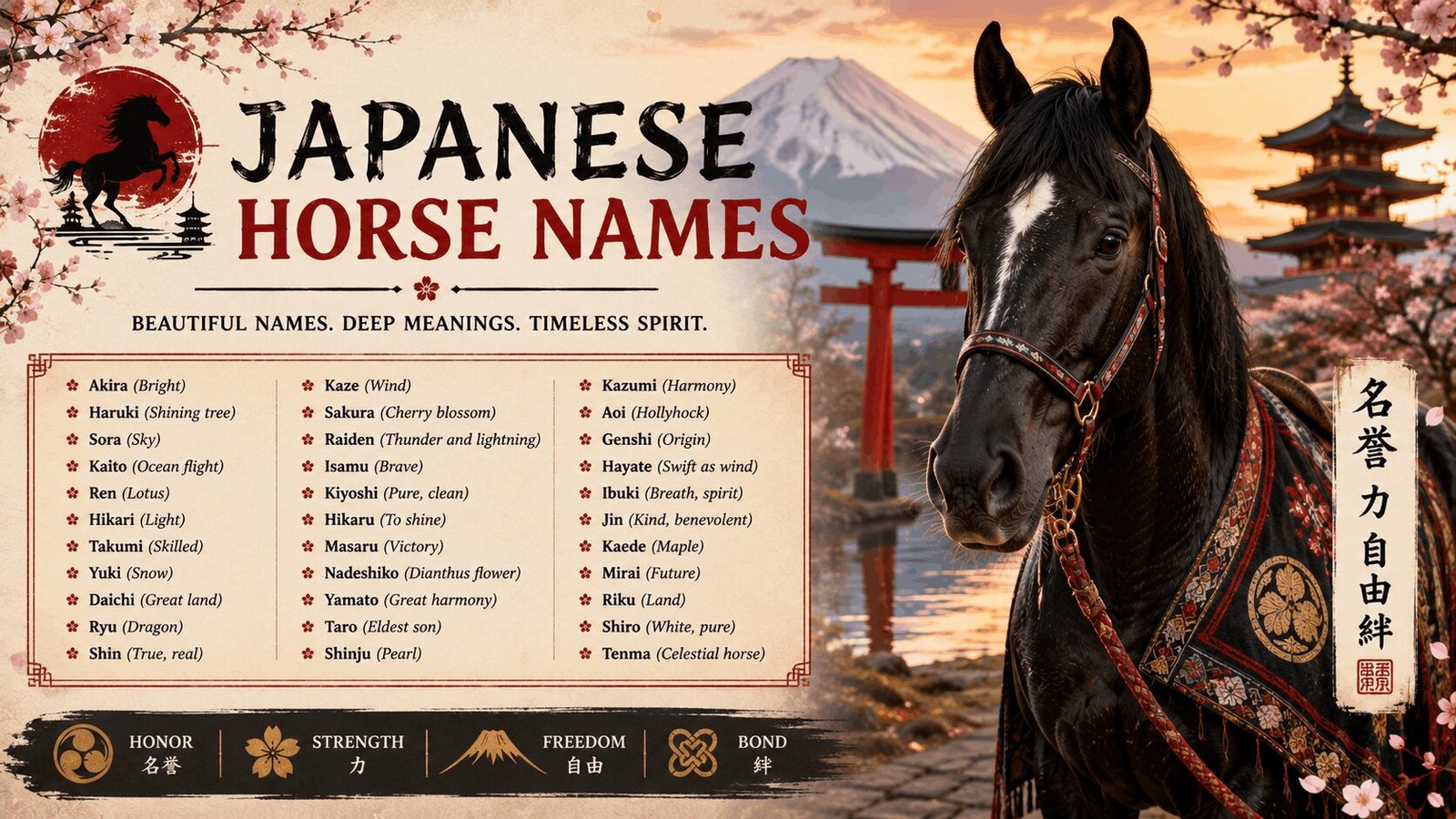
Names drawn from this culture carry a precision and layered meaning that English naming simply does not produce. A Japanese name can hold nature, season, emotion, and character in two syllables.
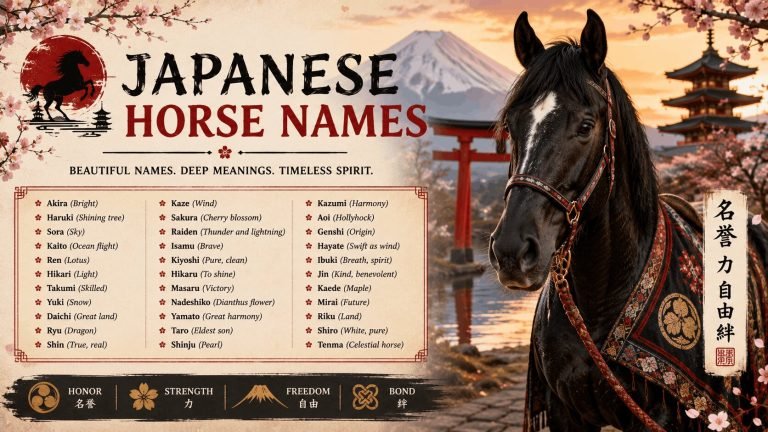
in this article I shared with you over 100 Japanese horse names, their meanings, kanji roots where relevant, and clear notes on which horse each name suits.
Let’s get started.
How to Choose a Japanese Horse Name
Japanese naming culture operates on a principle called kotodama, the belief that words carry living spirit. A name is not just identification. It is a declaration about what the named thing is and what it should become. This idea runs through Japanese horse naming the same way it runs through the naming of children, swords, and tea ceremony bowls.
I had a conversation at a racing event with a Japanese horse trainer who had relocated to the United States. He told me he named every horse he trained with a two-character Japanese word, always pairing a natural element with a quality. Wind and speed. Water and patience. Fire and will. He said it gave him a mental model for the horse every time he said the name. That stuck with me as one of the most practical approaches to naming I had ever heard, particularly if you are working with multiple horses and need each name to carry a distinct identity.
If your horse is a racing breed like a Thoroughbred or competing at any level where speed is the primary quality, Japanese names referencing wind, lightning, and swift movement suit both the animal and the cultural context. Japan’s racing tradition is built on Thoroughbred pedigrees, and many Japanese racehorses carry names following exactly this pattern.
If your horse is a slower, steady breed used for trail work or ranch work, names drawn from nature, seasons, and landscape carry better. The Kiso horse tradition favored names of endurance and mountain character rather than speed.
For mares, Japanese feminine names often draw from flowers, seasons, and water, giving you a wide range of sounds that carry elegantly when called at the stable or announced in a show ring.
You May Like More Horse Names
Popular Japanese Horse Names
These Popular Japanese Horse Names appear across Japanese equestrian culture, racing registries, and traditional horsemanship for a reason. They carry strong sounds and clear meanings and hold up well in both Japanese and English-speaking barn environments.
Japanese Male Horse Names
Male names in Japanese tradition often draw from warrior culture, natural forces, and the philosophical concepts of Zen and bushido. A well-chosen male Japanese horse name carries intensity without aggression, which reflects the ideal of the samurai horse: controlled power in service of a higher purpose.
You May Like More Horse Names
Japanese Female Horse Names
Japanese mare names carry a softness in sound that matches beautifully with the fluid nature of good equine movement. Many draw from seasonal imagery, particularly spring and autumn, which hold special significance in Japanese aesthetic tradition. The concept of mono no aware, the gentle sadness of beautiful things that pass, runs through many of these names in a way that gives them unusual depth.
Japanese Horse Names from Mythology and Samurai History
Japan’s mythological tradition gives horse names a weight that purely aesthetic choices cannot match. In Shinto mythology, horses were considered divine messengers and were dedicated to shrines. The white horse in particular held sacred status and was offered to Shinto shrines as recently as the medieval period. Naming a horse after a mythological figure or samurai is not decorative. It places the horse inside a lineage of meaning.
The connection between horses and Japanese military history runs particularly deep. Samurai cavalry, or kiba butai, shaped Japanese warfare for over five centuries. The horse was not just a tool but a partner in battle, and horses of exceptional quality were given names that carried the same respect as the warriors who rode them.
Japanese Horse Names Inspired by Nature and Seasons
Spring and autumn dominate Japanese nature naming because they represent the two moments of most intense natural beauty in the Japanese aesthetic tradition. A spring name carries hope and newness. An autumn name carries depth, fire, and the beautiful quality of things at their fullest before they pass.
Conclusion
Japanese horse names give you access to something most Western naming traditions do not offer: the concept of kotodama, the idea that a name carries a living spirit and shapes what the named thing becomes. Choosing a Japanese name for your horse is not just picking a word. It is setting an intention.
The most practical takeaway from Japan’s naming tradition is the two-element pairing method: combine a natural element with a quality and you get a name that is both specific and expansive. Hayate pairs wind with swiftness. Raijin pairs thunder with divine force. You can apply this principle to find combinations not listed here, particularly if none of the names above perfectly captures what you see in your horse. Start with the element your horse makes you think of, then find the quality that sharpens it. That is how the best Japanese names have always been built.
FAQs

About Me
I’m Daniel Carter, an equine researcher and horse-naming specialist at newHorseNames.com. I focus on creating meaningful and authentic horse names using trusted equine resources, breeder records, and expert insights. My research covers horse bloodlines, behavior, and naming traditions to ensure each name reflects true identity and purpose. Through accurate, well-researched content, I aim to help horse owners and breeders find distinctive and reliable names they can trust.