Equine Naming Companion
Horse Name
Generator
Discover the perfect name for your magnificent companion
Horse Name Generator: Find the Perfect Name for Your Horse
You brought a horse home, and now you are staring at a blank page trying to name it. The list you found online has two hundred generic suggestions that all feel wrong. “Thunder.” “Blaze.” “Star.” Every name either sounds like a stock photo caption or belongs to someone else’s horse already. Naming a horse is harder than it looks, particularly if you want something that actually fits the animal standing in front of you.
The problem is not that good horse names don’t exist. The problem is that most lists give you names with zero context. You get the name, but not the reason behind it, not the history it carries, and no guidance on whether it matches your horse’s coat, breed, or personality. A Friesian stallion and a palomino quarter horse do not need names from the same list. That gap is exactly what this guide solves.
Below you will find a full breakdown of how the horse name generator works, color-based name lists with real meanings, breed-specific suggestions, a practical four-check decision framework, and tips on registry rules before you commit. Start with the section that fits your situation right now.
What Is a Horse Name Generator?
A horse name generator is a tool that produces name suggestions based on filters you set before generating. The best ones don’t just spit out random words. They pull from structured categories: mythology, nature, color associations, historical figures, and linguistic roots from languages like Gaelic, Latin, Arabic, and Old Norse.
The generator on this page lets you filter by six criteria: gender, coat color, breed, style, word count, and starting letter or sound. You also choose how many names to generate, up to ten at a time. Each result shows its meaning beneath it, which matters more than most people expect when they first use the tool.
Why meaning matters practically: When you register a horse with a breed registry like the Jockey Club or the American Quarter Horse Association, the name often goes on the papers permanently. A name you picked because it “sounded cool” at week one becomes the official record for the horse’s lifetime, more so than almost any other decision you make in those first days.
Six of the generated examples shown in the interface above demonstrate the range the tool covers. Muircann (sea white) and Donnchadha (brown warrior) are Celtic. Quetzalcoatl (feathered serpent god) is Nahuatl from Aztec tradition. Apollonia (from Apollo) is Greek. Sophronia (sensible mind) is also Greek but with a completely different character. Odin (Allfather of the gods) is Old Norse. None of these belong on the same horse. That is the point of the filters.
How It Works
The generator takes your filter inputs and matches them against a curated name bank organized by category, meaning, and cultural association. Set your preferences, hit Generate, and you get up to ten names with their meanings displayed directly beneath each one.
The six filters work independently, so you can use one or all of them. Here is when each filter actually changes your results in a meaningful way, not just in appearance but in outcome:
Gender narrows names to those traditionally used for mares versus stallions or geldings. Some names carry a cultural gender association even when they don’t look obvious at first glance. Brynhildr, for instance, is a female name in Norse tradition regardless of how strong it sounds.
Coat color ties names to visual identity. A horse named Donnchadha, meaning “brown warrior,” pairs cleanly with a bay or dark liver chestnut. Muircann, meaning “sea white,” suits a grey or cremello better than it suits a dark coat. You can explore the full coat-specific lists further down in this article for each color group.
Breed is the filter most people skip, which is a mistake. A Thoroughbred, an Andalusian, and a Mustang carry different cultural histories. A name rooted in Spanish nobility fits an Andalusian the way a Celtic name fits a Connemara pony. Matching the name’s cultural origin to the breed’s geographic background creates a coherence most riders never think about until someone at the barn asks where the name came from.
Style lets you choose between categories like mythological, nature-based, historical, warrior, regal, or playful. This is the filter that separates a name like Quetzalcoatl from something like Sophronia. Both are strong names. They belong to completely different horses.
Word count matters for practical reasons. Single-word names are cleaner in competition programs and easier to call across a paddock. Two-word names carry more character but require a natural shortening for daily use, especially when the barn name becomes the only one that gets used after the first month.
Starts with is the filter you use when you already have a sound in mind, whether because of a breeding program naming convention, a family tradition, or just a strong gut preference for a particular letter.
Color-Based Horse Names
Coat color is the most overlooked naming shortcut. A name that references the horse’s color works at every level: it is descriptive, memorable, and holds up at the registry level because it is original enough to clear the uniqueness check most registries require. The names below are organized by coat group. Each includes a meaning and origin so you are choosing with real information, not just sound.
Select your horse’s coat color to see curated name suggestions, plus the dedicated resource page for even more options:
Grey horses have a color that changes throughout their life, often darkening before lightening to near-white. Names tied to silver, cloud, mist, and ocean imagery work best here, particularly if you want the name to hold as the coat shifts. For a deep list, visit our full guide on grey horse names.
Bay is the most common coat color in the world, which means the naming pool is crowded. A name that references earth, warmth, or strength without using obvious brown-color words gives a bay horse something distinctive. Our full bay horse names guide covers over a hundred options with meanings.
Black horses carry a visual power that the name needs to match. Flat generic names like “Midnight” or “Shadow” waste that presence. Names rooted in mythology, primordial concepts, or night imagery earn that coat. The complete resource for black horse names breaks this down by origin and tone.
Palomino coats range from pale cream to deep gold, and the best names reflect that spectrum indirectly. Names referencing sunlight, gold, or warmth carry the color meaning without stating it outright. See the full list of palomino horse names for more options across every naming style.
Roan coats mix base color with white hairs throughout, creating a visual depth that most single-color names miss entirely. Names referencing salt-and-pepper imagery, mixed elements, or dual nature work well here. Browse the dedicated roan horse names page for a full curated list.
Buckskin horses carry a tan or gold body with dark mane, tail, and legs, giving them a wild, untamed look. Names tied to the American West, desert landscapes, or ancient warrior cultures often feel exactly right. The full buckskin horse names list covers Western, mythological, and nature-based options.
Dun horses carry the dorsal stripe and primitive markings that link them back to prehistoric horse ancestry. Names that acknowledge that ancient lineage carry real weight. For the complete resource, visit the dun horse names
Paint horses have one of the most visually distinctive coats of any breed, with bold patches of white and a base color. That dual-color pattern opens naming possibilities most single-color horses don’t have. Find more ideas in the full paint horse names collection.
Red and chestnut horses have a warm copper coat that photographs beautifully but is genuinely difficult to name well. Most chestnut names either lean too obviously red or ignore the color entirely. Visit the red horse names guide for a deep pool of options organized by style.
Brown horses, particularly dark liver chestnuts and seal browns, deserve names that match their depth rather than their surface color. The full brown horse names guide goes deep into cultural names where brown carries nobility, strength, and ancient lineage.
True white horses are rare, and a name that treats that rarity with the right weight makes a lasting impression at the registry and at the show. Browse the full white horse names resource for names organized by mythology, nature, and origin language.
Names by Gender
Gender shapes a name’s feel more than most people admit. A name that sounds commanding and right for a stallion can land wrong on a mare, not because there is a rule, but because the cultural weight behind most names carries a gender assumption built over centuries. The filters for female horse names and male horse names on this site separate those pools properly so you’re not searching through names that will never fit.
For mares, names with a bit of elegance or natural power without being overtly masculine tend to hold up best over a lifetime. Strong options include Sophronia (sensible mind, Greek), Apollonia (from Apollo, sun god), Brigid (Irish goddess of craft and fire), Galatea (milk-white, Greek mythology), Saoirse (freedom, Irish Gaelic), Duquesa (duchess, Spanish), and Zafira (victorious, Arabic). The best mare names carry meaning rather than just sound.
For stallions and geldings, names that project strength or history without tipping into parody work best. Odin, Sigurd, Ruslan, Aldric, Castor, and Farouk all hold up across the arc of a horse’s working life, particularly if you want a name that reads well in a competition program as much as it sounds right in the barn.
Horse Names by Breed
Breed matters more than most naming guides admit. The connection between a horse’s geographic origin and the naming tradition of that region is not arbitrary. It reflects something real about the breed’s history, the culture that shaped it, and the coherence that comes from matching the name to the animal’s roots. Select a breed below to see curated suggestions.
Thoroughbred naming has strict rules set by the Jockey Club. Names can’t exceed 18 characters including spaces. They can’t duplicate names already on the active list or retired names of famous horses, and they can’t match recent Grade 1 or Grade 2 stakes winners. Greek and Roman mythology dominate because the connotations of speed, divine favor, and power align perfectly with racing culture.
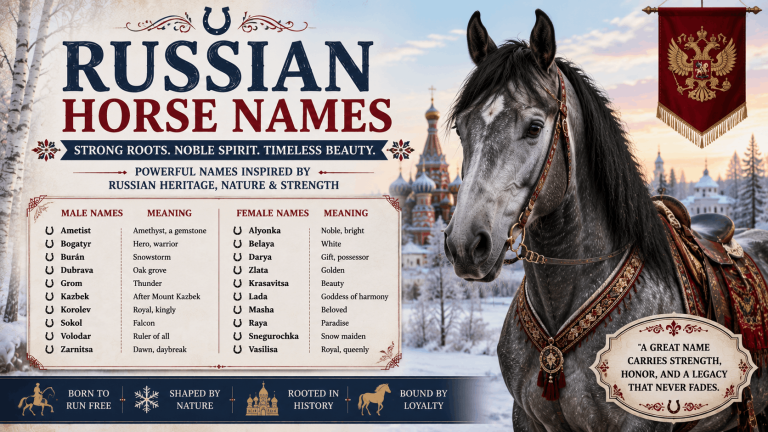
Arabians have one of the oldest documented breeding histories of any horse, and Arabic names carry a natural fit. Many registered Arabians carry Arabic names tied to the desert, speed, or nobility, and the registry accepts them readily because they are authentic to the breed’s origin.
Friesians are Dutch in origin, but their dramatic black coats and arched necks have made them the horse of choice for medieval and fantasy imagery. Norse, Germanic, and medieval names fit them naturally, particularly for the stallion lines that carry the classical Friesian presence.
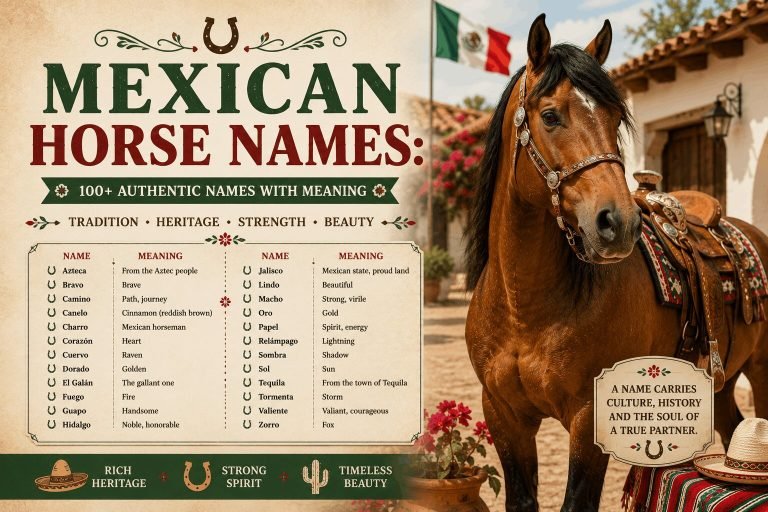
Quarter Horses are American through and through. Their naming culture is looser than Thoroughbreds, and the style runs from Western ranch to playful to family-name traditions. The breed’s history ties to cattle work, rodeo, and the American frontier, so names with that flavor tend to feel exactly right.
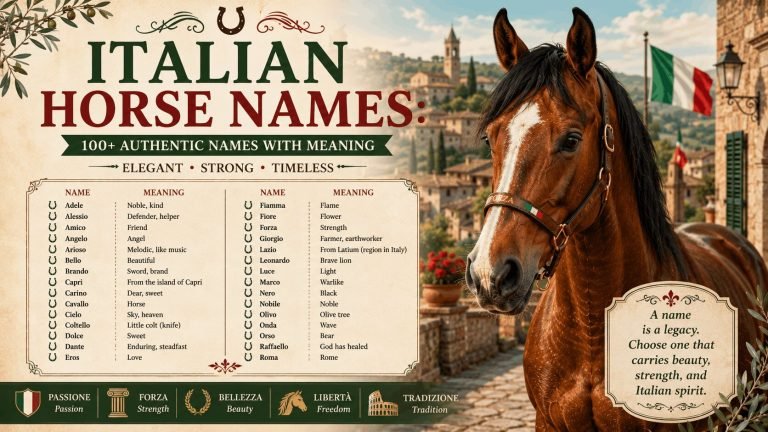
Spanish and Portuguese names are the natural fit for Andalusians, though the Moorish influence on Iberian horse culture also opens up Arabic options. Andalusians carry one of the most distinguished histories in European horsemanship, and the name should reflect that standing.
Connemaras come from the west of Ireland, and Irish Gaelic names give them an identity that generic pony names never will. The breed carries a landscape in its DNA, tough, beautiful, and shaped by Atlantic coast weather. The name should carry that same character.
Tips for Naming Your Horse: Making the Perfect Choice
I named my first horse on day three of owning her. She was a dark bay Thoroughbred off the track, and I called her Meridian because I liked the word. Six months later, every person at the barn called her “Merry,” which suited her exactly zero percent.
She was not a “Merry” kind of horse. She was precise, a little suspicious, and very fast. The name I had chosen sounded great in my head and meant nothing to the actual animal or the people who worked with her daily. That experience taught me to think harder about how a name actually lives in daily use before committing.
Registry Requirements and Rules
Before you fall in love with a name, check the registry rules. Breed registries vary significantly in what they allow, and finding out a name is unavailable after you’ve already started using it at the barn is a frustrating way to learn this lesson.
The Jockey Club limits Thoroughbred names to 18 characters, bans names identical to famous horses within the past 25 years, and prohibits names that are “undignified, suggestive, or offensive.” Names consisting entirely of numbers or initials are also not accepted.
The American Quarter Horse Association allows up to 20 characters and requires that names not duplicate names already in the AQHA database. The process is first-come, first-served, so popular names fill fast, especially names tied to famous horses from the last two decades.
The United States Equestrian Federation uses a separate show name system, which means a horse can carry one registered name and a different show name, particularly useful when the registered name is long or difficult to announce clearly over an arena speaker.
Making It Work in Real Life
A name functions at three levels: the full registered name on the papers, the show name called over the arena speaker, and the barn name used fifty times a day. All three can be different, or they can all be the same. Odin is a name that works at all three levels without adjustment. Quetzalcoatl is a name that becomes “Quetz” or “Coatl” by day two, which are both actually fine and carry their own personality.
Taking Your Time
Most guides tell you to wait a week before naming a horse so the personality can emerge. That is only partially true because it frames the delay as being about the horse. The fuller picture is that your perception of the horse needs a week to settle. You see different things in an animal on day one than you see on day seven, not because the horse changed, but because the novelty wore off and the actual personality became visible. Set a ten-day observation window, then make the call. Indecision doesn’t produce a better name.
The Practical Side
Short names are called faster in real situations, particularly when the horse is loose in a back pasture and you are at the gate. A one-syllable or two-syllable name with a clear consonant at the start carries across distance better than a vowel opener like “Aura” or “Ember.”
Names that end in a hard vowel sound, particularly “-ee” endings, tend to get faster recognition responses from horses. The high-pitched terminal vowel sits in a frequency range horses track well. That acoustic fact is why barn names like “Rosie,” “Freddie,” and “Buddy” get reliable responses. It is not just affection; there is a practical reason it works, especially when everything else is in order and you need the horse to locate your voice among ambient barn noise.
Names that start with “wh-” or “sh-” sounds are harder for horses to distinguish as calls because they blend with wind noise and ambient barn sounds. Worth knowing before you commit to “Shadow” or “Whisper,” not because of what seems obvious, but because the acoustic problem only shows up consistently after several months of daily use.
Making the Final Decision
Run every candidate name through these four checks before committing. A name that passes all four is the right choice, even if a longer list of alternatives looked more interesting on paper.
- 1 Say it ten times fast. Not as a joke exercise. Literally say the name ten times in a row, the way you would call a horse across a field. If it becomes awkward or blurs into something else, that is a practical problem you will live with for fifteen years.
- 2 Write it in a vet record context. “Patient: [name]. Owner: [you].” See if it looks right on paper. Official documents will carry this name across the horse’s entire medical and competition history.
- 3 Tell three non-horse people the name and the meaning. Their reaction is a rough proxy for how the name will land with judges, spectators, and family members who don’t follow equestrian sport. You don’t have to care what they think, but their response tells you something about the name’s legibility outside your own head.
- 4 Live with the shortening. Whatever the natural shortened version of the name is, make sure you are comfortable with it. You will use the shortening more than the full name. If the full name shortens to something you dislike, reconsider the full name rather than the shortening.
Still narrowing down? The color tabs and breed panels above cover over 80 curated names with full meanings. If your horse is a specific color, running through that panel first cuts the search time in half, more so than any other single filter the generator offers.
Conclusion
Picking a horse’s name is one of the few decisions you make for an animal that stays with them for their entire life, shows up in every official record, and shapes how every person who meets them perceives them before they know a single thing about the horse. Most naming articles treat it like a fun list exercise. It is closer to a commitment with real practical weight behind it.
The generator gives you structured options tied to real meanings, with filters that account for coat color, breed, gender, and style so you are not picking from a pool that was never built for your specific horse. The color and breed sections above go deeper than any generic list, and the four-check framework gives you a consistent way to test any name before you engrave it on the gate sign. The right name is usually the one that felt obvious by day eight and only needed a registry search to confirm it was available.
Quick Takeaways
- Filter by coat color first when using the generator; names with meanings that match the horse’s appearance clear registry uniqueness checks more often than generic names.
- Check breed registry name availability before deciding, since popular names fill up fast and some registries only allow one name change.
- Short names with clear consonant openings carry across distance better in an open field and get faster vocal recognition from the horse.
- The barn name will be used more than the full registered name, so confirm the natural shortening works before you commit to the full version.
- Wait seven to ten days before naming a new horse, then set a deadline and commit; indecision doesn’t improve the name.
- Run every candidate name through four checks: say it ten times, write it in a record context, explain it to a non-horse person, and live with the natural shortening.
- Names rooted in the breed’s cultural and geographic origin create a coherence that generic lists never produce, especially in breed-specific competition settings.
Frequently Asked Questions
A good horse name fits the horse’s appearance, personality, and breed background, works as a barn name in daily use, clears the registry availability check if registration is required, and sounds clean when called across a field. Short names with a strong consonant opening tend to get better vocal response from horses. The best names also carry a meaning that holds up when someone asks about it, rather than relying entirely on how the word sounds in isolation.
Start by filtering the generator by your horse’s coat color and breed, then cross-check results against your registry database before committing. Names rooted in less-common languages like Gaelic, Nahuatl, Old Norse, or Arabic tend to be more available in breed registries than Latin or Greek names, which have been heavily used in Thoroughbred naming for decades. Pair a distinctive origin language with your horse’s visual identity for something genuinely specific to that animal.
The most recognized include Bucephalus (Alexander the Great’s horse), Marengo (Napoleon’s Arabian), Copenhagen (Wellington’s horse at Waterloo), Pegasus (winged horse of Greek myth), Sleipnir (Odin’s eight-legged horse in Norse mythology), and Arion (the divine horse of Greek myth born from Poseidon). Each carries a distinct cultural origin and a story behind it that adds weight to the name beyond the sound alone.
Strong mare names carry meaning rather than just sound. Top options include Sophronia (sensible mind, Greek), Apollonia (from Apollo, sun god), Brigid (Irish goddess of fire and craft), Galatea (milk-white, Greek mythology), Saoirse (freedom, Irish Gaelic), Duquesa (duchess, Spanish), and Zafira (victorious, Arabic). Browse the full female horse names guide for over 100 curated options organized by style and origin.
Yes, horses recognize their name as a cue, though more through tone, rhythm, and consistent association than through language comprehension the way a dog might. Names with two syllables and a strong ending vowel, particularly “-ee” or “-ah” endings, tend to get faster recognition. Consistency matters more than the name itself. A horse called “Mango” consistently will respond faster than a horse whose name varies depending on who is calling.
Color-based names work best when they reference the color through meaning rather than stating it outright. Erebus for black horses (Greek primordial darkness). Aurelius for palominos (Latin for golden). Galatea for greys (Greek for milk-white). Sienna for bays (Italian earth pigment). Nimbus for dapple greys (Latin for rain cloud). Each carries the color association without making the name feel like a description. Dedicated guides for black horse names, palomino horse names, and grey horse names go deep into each color group.
Most breed registries allow one name change, and some charge a fee. The Jockey Club does not allow name changes for Thoroughbreds after the name has been used in a race. The American Quarter Horse Association allows one change before the horse reaches a set age threshold. Always check the current rules for your specific registry because these policies update and vary by region. This is worth verifying before you start using a name at the barn informally.