Italian Horse Names: 100+ Authentic Names With Meanings
Quick Takeaways
Picking a name for your horse feels exciting right up until you spend forty minutes clicking through lists that hand you “Bella,” “Luna,” and “Fuoco” with zero context behind any of them. No meaning. No regional origin. No guidance on whether Fuoco suits a gray Lipizzan or a chestnut Thoroughbred. That gap makes the whole search feel like a waste of time, particularly when you know Italian has one of the richest naming traditions in European equestrian culture.
The problem runs deeper than lazy lists. Most articles treat Italian horse names as a sound choice, something that rolls off the tongue nicely during a show introduction. They pull ten words from a basic Italian dictionary and call it a resource.
What they skip entirely is the fact that Italy produced Federico Caprilli, the cavalry officer whose forward-seat riding system in the early 1900s permanently changed how the entire world trains horses.
They skip the Maremma, the ancient semi-wild horse breed of Tuscany whose herd management tradition shaped Italian naming culture for centuries. They skip UNIRE, Italy’s horse racing authority, whose registered Thoroughbred naming rules mirror the Jockey Club’s 18-character limit and carry their own cultural fingerprint.
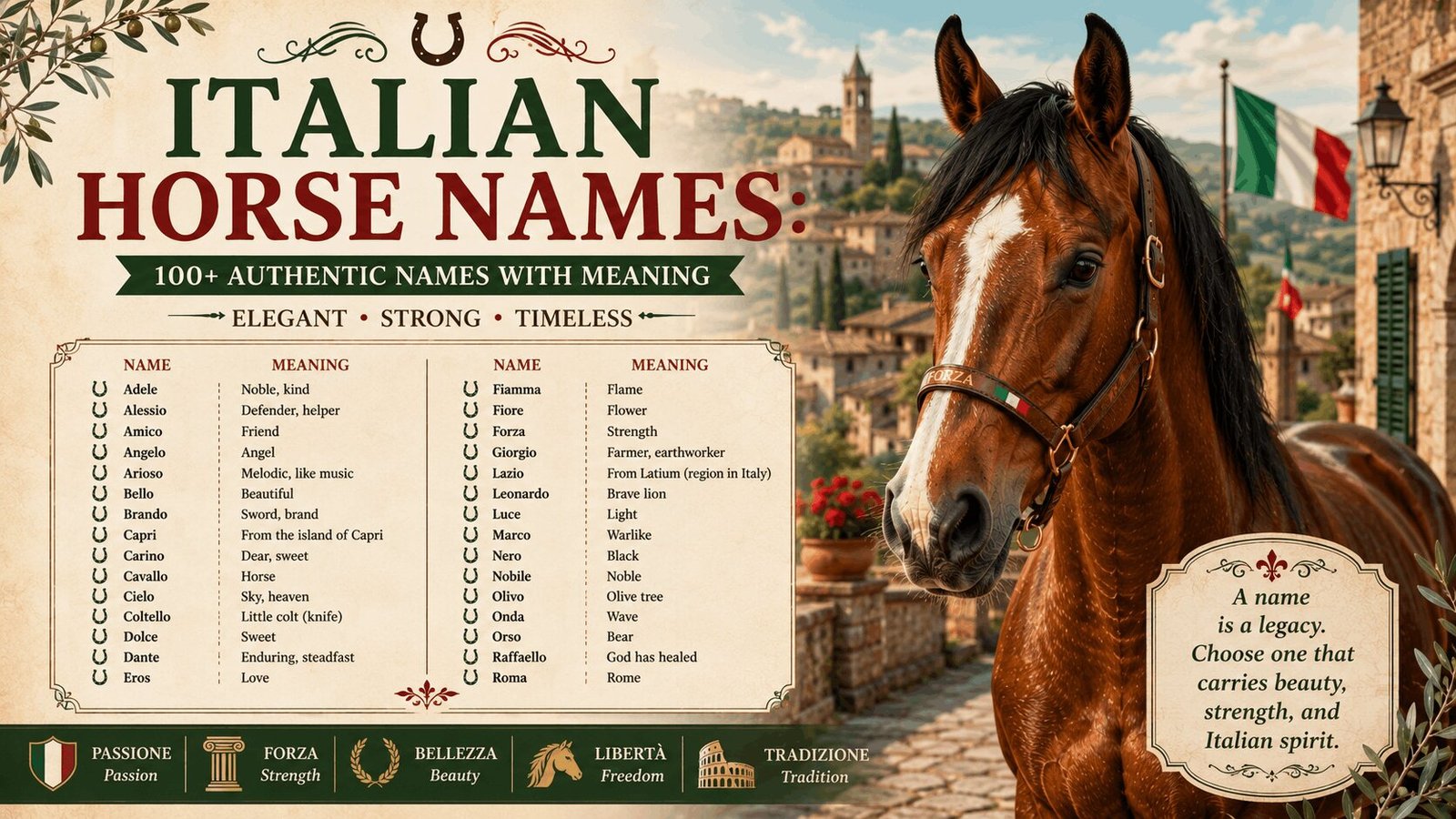
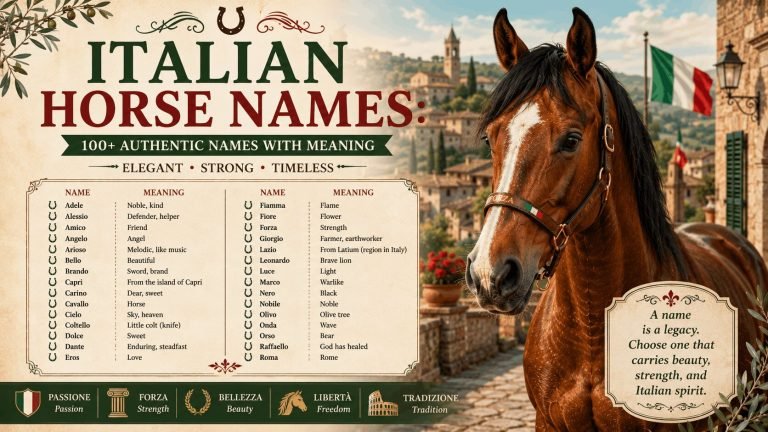
In this article i give you over 100 Italian horse names with meanings, cultural origins, and clear notes on which horse each name fits. We also walk you through how to match a name to coat color, gender, and personality so the choice holds up ten years from now.
Before getting started, I recommend you check out our female horse names or male horse names guides; they are dedicated to genders with different types and categories.
How to Choose an Italian Horse Name
Most guides tell you to pick a name you love the sound of. That is only partially true because a horse name functions as a daily working word, not just a label on a registration document. The fuller picture is that the names lasting twenty years are the ones rooted in something real about the specific horse in front of you.
I learned this the hard way with a Maremmano gelding I named Tempesta, the Italian word for storm, after watching him move with what I thought was electric energy during his first week at the stable. Three months into groundwork and basic horse training, he turned out to be one of the calmest, most patient horses I had ever worked with.
The name felt wrong every time I called it across the barn. I eventually shifted to calling him by his registered show name and used a shorter barn name daily. The lesson that fell into place for me was simple: name the horse you have after week four, not the horse you imagine on day one.
If your horse is a registered Thoroughbred competing under UNIRE, Italy’s horse racing authority, note that Italian racing names follow a strict character limit and cannot duplicate the names of significant historic Italian racehorses, much the same way the American Stud Book governs Thoroughbred naming in the United States. Ribot, Nearco, and Donatello are permanently retired from Italian racing registries. Using those names for a competition horse will get a registration rejected.
If your horse is a Lipizzan, Maremmano, or Italian Trotter breed, a name from the specific regional tradition of that breed carries more accuracy than a generic Italian word. Lipizzan stallions at the Spanish Riding School follow a strict six-line naming convention.
Maremmano horses from Tuscany traditionally carried names tied to the Maremma landscape: wind, marshland, salt flat, and the specific cypress-lined roads of that coastal region.
Coat color gives you the fastest shortcut. Gold and fire names suit chestnuts and palominos. Shadow and night names work on blacks and dark bays. Silver and water names pair naturally with grays and blue roans. Earth names suit bays, browns, and duns.
If your horse is young and still in active training, choose a name with one or two syllables, particularly if you rely on voice commands during groundwork. Short names cut through stable noise and register faster, more so than most new owners expect until they are standing in a windy field trying to call a horse that does not respond to four syllables.
If your horse is an older equine companion used for trail or pleasure riding, longer Italian horse names work well as registered names while a shortened version handles daily barn use. Magnifico becomes Fico. Valoroso becomes Valo. The full name gets announced. The short name gets used.
Popular Italian Horse Names
Popular Italian horse names appear consistently across Italian equestrian registries, UNIRE racing records, and Maremmano breeding tradition because they carry strong sounds and clear meanings that hold up in both Italian and English barn environments.
Italian Male Horse Names
Italian stallion and gelding names draw from three distinct traditions: the classical Roman world, the regional landscape of the Italian peninsula, and the virtue-based naming culture of Italian cavalry and equestrian academies. The best male Italian horse names sit at the intersection of strong consonant sounds and clear meaning, which matters during horse training when a name needs to carry authority across a noisy arena.
Federico Caprilli, the Italian cavalry officer who developed the forward seat system between 1902 and 1907, trained horses under names that reflected the animal’s dominant quality rather than its appearance. That principle still holds. A name drawn from a character lasts longer than a name drawn from coat color, particularly if the coat changes seasonally and the character does not.
Italian Female Horse Names
Mare names in Italian tradition carry a musicality shaped by centuries of classical culture, particularly in Tuscany, Lombardy, and the Veneto, where horse breeding and artistic tradition developed side by side. The best Italian mare names end in vowels, which travel further when called across open pasture and sit more comfortably in a show ring announcement, especially when everything else is in order and the name itself needs to land cleanly.
- Allegra: Joyful and lively, Italian; bright-natured and expressive, suits a spirited mare.
- Ambra: Amber, Italian; warm golden tone, suits a palomino or light chestnut mare.
- Anima: Soul or spirit, Italian; deeply bonded and expressive, suits a companion mare.
- Argentа: Silver, Italian; gray or roan mare with a cool metallic coat quality.
- Bellezza: Beauty, Italian; visually exceptional, it suits any particularly striking mare.
- Bianca: White, Italian; clean and direct, suits a white or light gray mare perfectly.
- Cadenza: Musical cadence, Italian; rhythmic mover, suits a dressage or classical mare.
- Calma: Calm, Italian; steady and unbothered, suits a beginner or therapy horse mare.
- Canzone: Song, Italian; expressive and vocal, suits a mare that communicates loudly.
- Cara: Beloved, Italian; deeply bonded to rider, perfect for a long-term companion mare.
- Chiarа: Clear and bright, Italian; luminous coat, suits a palomino or bright bay mare.
- Danza: Dance, Italian; expressive gait and presence, suits any showy performance mare.
- Dolce: Sweet, Italian; gentle and easy, ideal for a beginner’s first horse.
- Eleganza: Elegance, Italian; fluid and refined, perfect for a dressage or breed show mare.
- Eternа: Eternal, Italian; suits a mare with a timeless quality and reliable character.
- Farfalla: Butterfly, Italian; unusual markings or spotted coat, suits a pinto mare.
- Fiore: Flower, Italian; delicate and pretty, fits a fine-boned light-framed mare.
- Forza: Strength, Italian; strong-willed and athletic, suits a sport competition mare.
- Gioia: Joy, Italian; consistently happy and social, perfect for a barn-friendly mare.
- Gloria: Glory, Italian; standout performer, suits a mare that wins in the show ring.
- Grazia: Grace, Italian; fluid and elegant mover, suits a classical dressage mare.
- Luce: Light, Italian; luminous and bright, suits a palomino or light-coated mare.
- Magia: Magic, Italian; captivating and unusual, suits a horse with a rare quality.
- Nebbia: Fog or mist, Italian; soft and elusive, suits a light gray or smoky-coated mare.
- Nuvola: Cloud, Italian; drifting and soft, suits a light gray or dapple-coated mare.
- Perla: Pearl, Italian; a white or gray mare with a luminous coat and quiet temperament.
- Primavera: Spring, Italian; young and fresh, suits a spring-foaled energetic young mare.
- Regina: Queen, Italian; dominant herd mare with visible authority and presence.
- Rosa: Rose, Italian; gentle and beautiful, suits a pink-nosed or light chestnut mare.
- Serena: Serene, Italian; calm and composed, suits a steady, reliable performance mare.
Here is the part most naming guides cut entirely. The name you choose carries weight not just at registration but every single time it is called during a training session, announced at a G1 race, read from a horse pedigree document, or attached to a horse’s identity for the next twenty years.
A name that sounded good on day one can become friction by year three, particularly if it never actually fit the horse’s character to begin with. Choose the horse you observe, not the horse you hope for.
You May Like More Horse Names
Italian Horse Names from History and Mythology
Italy’s equestrian history runs from Roman cavalry through Renaissance court riding academies to the Caprilli forward-seat revolution and modern Olympic sport horse breeding. Names drawn from that lineage carry a weight that purely aesthetic choices cannot match, which matters more than it sounds when a horse will carry its name through a full competitive career or breeding record.
The unexpected fact worth knowing here: Nearco, foaled in Italy in 1935 and trained by Federico Tesio, is considered by many bloodstock experts to be the most influential Thoroughbred sire of the 20th century.
His bloodline appears in the pedigree of virtually every modern Thoroughbred racing today. He was Italian-bred and Italian-named, and his name is permanently retired from UNIRE racing registries. Any horse name with that level of historical weight shapes how the entire equestrian world perceives the animal carrying it.
Italian Horse Names Based on the Italian Landscape
Italy’s geography spans Alpine peaks, Po Valley flatlands, Tuscan hills, volcanic islands, and the Maremma coastline. Each of those landscapes carries a distinct naming tradition, particularly within the regional horse breeds that developed in those specific environments.
A name drawn from the actual land where a horse lives or was bred carries authenticity that a generic Italian word never reaches.
The Maremmano breed from Tuscany spent centuries as a working cattle horse on the coastal marshes and pine forests of the Maremma. Butteri, the Tuscan cowboys who worked those horses, named their animals after the specific features of that flat coastal landscape: salt flats, sea wind, marsh reed, and the low silver light of a Tuscan morning.
That regional specificity is exactly the kind of detail that makes a name stand the test of time rather than fade into generic barn conversation.
Italian Horse Names for Coat Colors
Matching a name to coat color is one of the oldest naming traditions in Italian equestrian culture, and it works better in Italian than almost any other language because Italian has specific, precise words for color shades that English does not.
The difference between bianco (white), argento (silver), and pallido (pale) gives you three distinct names for three distinct coat expressions, each carrying its own sound and weight, which most generic naming lists never go far enough to explain.
- Baio: Bay, Italian; classic and direct, suits any traditional bay-coated horse.
- Bianco: White, Italian; pure white coat, clean and unambiguous name choice.
- Bruno: Dark brown, Italian; deep brown coat, suits a dark bay or seal brown horse.
- Castano: Chestnut, Italian; warm red-brown, suits a standard chestnut horse directly.
- Cenere: Ash, Italian; a gray coat with a cool dusty tone that suits a dapple gray horse.
- Dorato: Golden, Italian; a palomino or golden coat suits a warm-toned bright horse.
- Grigio: Gray, Italian; clean and direct for any gray-coated horse of any shade.
- Morello: Dark bay or black bay, Italian; traditional racing coat name, suits a dark horse.
- Palomino: Palomino, shared between Italian and Spanish, has a golden coat with a white mane and tail.
- Pezzato: Spotted or piebald, Italian; unusual markings, suits a pinto or paint horse.
- Roano: Roan, Italian; mixed-color coat, suits any roan horse of any base color.
- Sauro: Chestnut with a matching mane, an Italian racing term that suits a solid chestnut Thoroughbred.
Italian Horse Names from Music and Art
- Allegretto: Moderately fast, an Italian musical term; suits a horse with a lively natural tempo.
- Andante: Walking pace, Italian musical term; suits a steady, calm horse with even rhythm.
- Aria: Song or air, Italian opera; elegant and expressive, suits a showy performance mare.
- Concerto: Musical concerto, Italian; harmonious and polished, suits a dressage horse.
- Fortissimo: Very strong, Italian musical term; a powerful and loud mover in the arena.
- Leonardo: Leonardo da Vinci; creative and exceptional, suits a uniquely talented horse.
- Libretto: The text of an opera, Italian; thoughtful and layered, suits a complex horse.
- Medici: Famous Florentine patron family; wealthy and powerful, suits a prized stallion.
- Michelangelo: Renaissance master; magnificent and rare, suits an exceptional horse.
- Moderato: Moderate tempo, Italian musical term; steady and reliable, suits a school horse.
- Presto: very fast Italian musical term; explosive speed, suitable for a sprint or racing horse.
- Stradivari: Master violin maker; rare and exceptional, suits a once-in-a-generation horse.
- Verdi: Giuseppe Verdi, Italian composer; powerful and dramatic, suits a bold stallion.
- Vivace: Lively and vivid, an Italian musical term; spirited mover, suits an animated horse.
- Vivaldi: Antonio Vivaldi, Italian composer; brilliant and seasonal, suits a bright horse.
Conclusion
Italian horse names give you access to something most Western naming traditions split across multiple cultures: classical history, regional landscape identity, musical tradition, and a living equestrian heritage that runs from Roman cavalry through Caprilli’s revolution to modern Olympic sport horse breeding. That range sits inside one language, and it gives you a name for every type of horse regardless of breed, coat, or purpose.
The reframe worth carrying forward is this: the Italian naming tradition, from the Maremmano butteri of Tuscany to the UNIRE Thoroughbred registries have always treated a horse’s name as the first statement of its identity
Ribot was not named after power by accident. Nearco was not named after an ancient legend casually. Every name in that tradition was chosen to say something true about the animal carrying it. Start with what is true about your horse, find the Italian word that captures it precisely, and the name will announce itself. That is how the best Italian names have always been built.
If you find this useful, please share it with your friends and barn owners.
FAQs

About Me
I’m Daniel Carter, an equine researcher and horse-naming specialist at newHorseNames.com. I focus on creating meaningful and authentic horse names using trusted equine resources, breeder records, and expert insights. My research covers horse bloodlines, behavior, and naming traditions to ensure each name reflects true identity and purpose. Through accurate, well-researched content, I aim to help horse owners and breeders find distinctive and reliable names they can trust.