80+ Best Buckskin Horse Names

  • Buckskin is a coat color produced by one copy of the cream gene on a bay base, not a breed designation.
  • Silver buckskins carry a cooler, more luminous tone and need names from a different category than warm-gold buckskins.
  • Color-based names work at any age; personality names are more accurate but require knowing the horse first.
  • Mythology names hold up best in show contexts because they translate well in programs and ring announcements.
  • Test any name out loud for a full week before registering it — a name that feels wrong when you are tired is the wrong name.
  • For geldings in working barn settings, one or two syllables with hard consonants hold up better over years of daily use.
  • Check the registration database before committing to a show name; duplicate names create paperwork problems and barn confusion.

You searched for buckskin horse names and landed on the same list recycled across a dozen sites. Butterscotch. Goldie. Tawny. The same words, in the same order, with no explanation of why any of them fit a buckskin specifically. That is not a resource. That is a copy-paste job with a headline.

The frustration is real because the need is real. Naming a horse is a long-term decision. A barn name sticks for twenty-five years. A registered show name follows a horse into every program, every record, and every sale document. Choosing from a random word pile with no context is how people end up with regrets, particularly when they realize six months later that the name fits the coat but misses the horse entirely.

I put this guide together to fix that. Names are organized by what actually matters: coat color, personality, mythology, food, nature, gems, and more. Each name includes a brief note on what makes it a good fit for a buckskin, and the tips section at the end explains how to choose, not just what to pick.
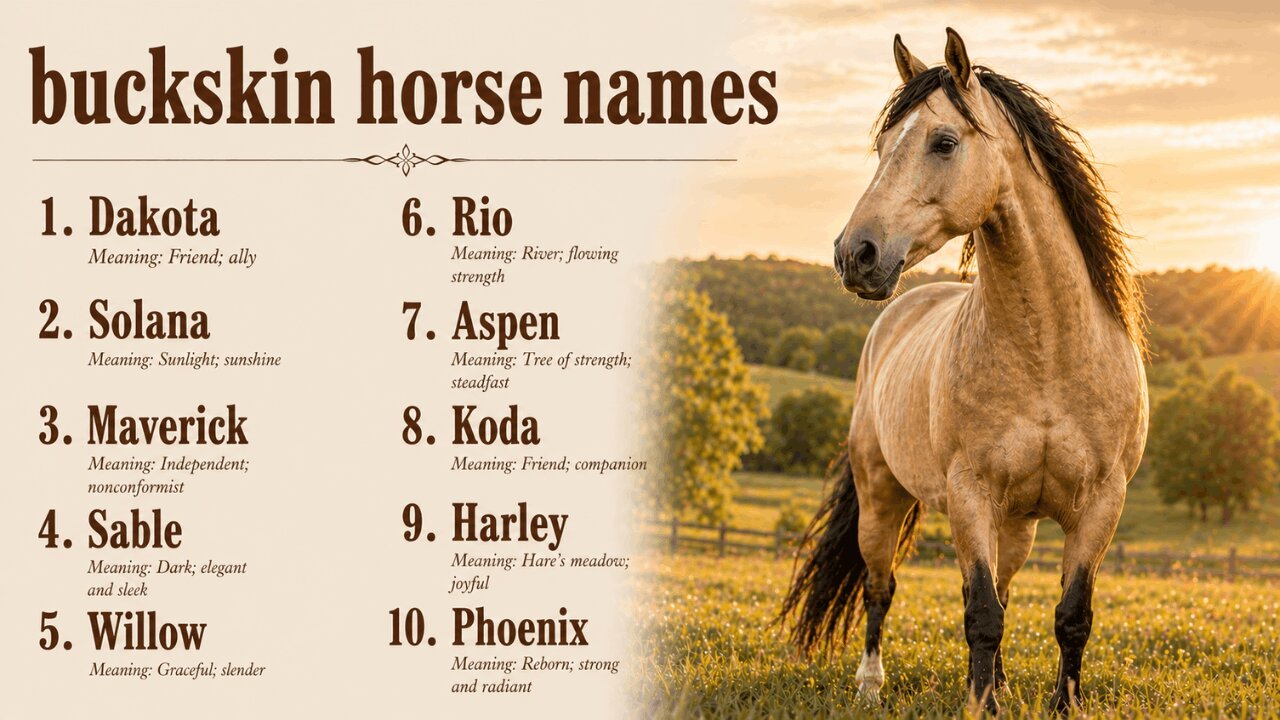
Buckskin Horse Names

Famous Buckskin Horse Names

Some of the most recognized horses in Western history and film were buckskins. Names drawn from this tradition carry a sense of lineage that purely aesthetic names cannot provide, which is why I find this category so useful and so frequently skipped by other guides.

If you ride Western or your horse works cattle, these names fit the context without any explanation needed.

  • Cisco — The buckskin ridden by the Cisco Kid in classic Western television
  • Buck — Simple, direct, and the root of the word “buckskin” itself; impossible to misplace
  • Comanche — The U.S. Cavalry buckskin who survived the Battle of Little Bighorn in 1876
  • Scout — The buckskin ridden by Tonto in The Lone Ranger; works for any dependable trail horse
  • Trigger Jr. — Roy Rogers’ buckskin, distinct from the palomino Trigger most people know
  • Ranger — A Western-canon name; suits a capable, dependable working horse in any setting
  • Wayfarer — A classic trail horse name with strong cultural resonance in Western riding tradition

A Quick Word on Buckskin Coloring

Buckskin is a coat color, not a breed. It appears when a horse carries one copy of the cream gene on a bay base coat. The result is a golden or tan body with black mane, tail, and lower legs. Those dark legs and mane are called “black points,” and they are part of what makes a well-chosen color-based name so satisfying when it acknowledges the contrast.

Important Tip

Here is something most naming guides skip entirely: some buckskins carry both the cream gene and the dun gene, producing what geneticists call a “buckskin dun.” These horses show primitive markings such as leg barring and a shoulder shadow in addition to the dorsal stripe.
If your horse has faint striping along the legs, that is ancient genetic memory, not a grooming problem. It is also worth noting that coat shade ranges from pale champagne to deep amber-gold. Silver buckskins carry a cooler, more luminous tone that standard warm-gold names simply do not suit, which is why I have included a dedicated silver section below.

Buckskin Horse Names Based on Color and Appearance

Color-based names age well. They fit a horse at two years and at twenty, especially when the name captures a specific shade rather than a general idea of “gold.” I always recommend starting here before moving to other categories, more so than most people expect when they first sit down to name a horse.

For Mares:

  • Saffron — The deep orange-gold spice; suits a rich, warm-toned coat with strong color saturation
  • Goldenrod — The wildflower with vivid yellow blooms; works for a bright, sunlit buckskin
  • Sienna — An earthy burnt-orange pigment; fits darker, reddish-gold mares with warm undertones
  • Flaxen — The pale gold of linen fiber; ideal for a creamy, light-coated mare
  • Ochre — An ancient golden-yellow pigment; suits a deep, matte coat that photographs beautifully
  • Topaz — A warm yellow gemstone; elegant and short enough for daily barn use
  • Cinder — For a mare with dark, smoky points and a strong dorsal stripe
  • Sahara — Named for the sun-bleached landscape; fits a pale, washed-out buckskin coat
  • Soleil — French for “sun”; refined, accurate, and easy to call across a pasture
  • Dune — The shape of windswept sand; works for a pale, smooth-coated mare
  • Harvest — The color of cut wheat fields in late summer; warm and unhurried
  • Marigold — The bright garden flower; suits a vivid, warm-toned coat with strong presence

For Geldings and Stallions:

  • Dorado — Spanish for “golden one”; strong, direct, and accurate for any working horse
  • Flint — The dark, sharp stone; suits a horse with dramatic black points and a bold look
  • Paladin — Calls up gold armor with dark trim; suits a bold, deep-colored horse with presence
  • Kodiak — The Alaskan island; works for a large, substantial, dark-coated horse
  • Sedona — The Arizona red-rock landscape; earthy, warm, and distinctly Western in feel
  • Caramel — A soft mid-tone buckskin with a friendly look; works well as a barn name
  • Gunsmoke — The haze of fired gunpowder; great for a horse with a dark overlay on the coat
  • Buckeye — The nut with a tan body and dark cap; matches the buckskin color pattern almost literally
  • Tundra — Cold and pale; for a very light, near-cream buckskin that does not suit warm-gold names
  • Coronado — The Spanish explorer who crossed the American West in gold armor; a name with history
  • Sable — For a horse where the black points dominate the overall impression

Buckskin Horse Names Based on Food

Food names are underestimated as a category. They are easy to call across a field, they stick in memory, and for buckskins the color connection is direct rather than forced. I recommend this category especially for barn names and trail horses, though not always in the way you expect. The key is choosing a food name that reflects the specific shade of your horse rather than picking the first warm-sounding word on the list.

  • Butterscotch — Pale gold and warm; slightly overused but genuinely accurate for a mid-tone coat
  • Praline — The caramel-brown French candy; more refined than Butterscotch and less common
  • Biscuit — Pale, warm gold; works as both a show name and a barn name without effort
  • Toffee — Darker and richer than Butterscotch; fits deeper golden coats well
  • Paprika — The reddish-gold spice; for a buckskin with warm, reddish undertones in the coat
  • Miso — Pale golden Japanese paste; unusual, short, and easy to call in any setting
  • Nutmeg — The warm brown spice; slightly dark and slightly sweet, like the coat it suits
  • Chai — The golden-brown tea spice blend; elegant and memorable without being fussy
  • Cornbread — Rustic, warm, and distinctly Western; pairs well with a casual barn environment
  • Molasses — For a very dark, deep-toned buckskin with rich, saturated coloring
  • Shortbread — Pale, soft, and understated; suits a light-colored, calm-natured horse

Buckskin Horse Names Based on Gems

Gem names carry natural weight. They work well for horses with genuine presence and strong conformation, more so than most people expect the first time they browse this category. A gem name on a plain-moving horse reads as “overreach.” On a horse with real elegance, it fits perfectly. This is one of the categories I return to most when helping someone name a mare heading into the show ring.

  • Citrine — The yellow-gold quartz crystal; one of the most accurate color matches for a buckskin coat
  • Amber — Fossilized tree resin in warm gold tones; timeless, easy to call, and rarely duplicated
  • Pyrite — “Fool’s gold”; for a horse that looks impressive and carries itself like it knows
  • Jasper — The earthy, warm-toned stone; suited to a grounded, steady temperament
  • Beryl — A golden-green gemstone variety; slightly unusual and refined as a registered name
  • Tiger’s Eye — The banded gold-brown stone; perfect for a horse with a layered, multi-toned coat
  • Cairngorm — The smoky Scottish gemstone; dramatic and rare, for a horse that is equally distinctive
  • Goldstone — The glittering copper glass suits a flashy, eye-catching horse with show presence

Buckskin Horse Names Based on Personality

Color names cover what the horse looks like. Personality names cover what the horse actually is. Most naming lists skip this category entirely, which explains why so many horses end up with names that stop feeling accurate the moment training begins.

A mare at a training facility in Colorado taught me this the hard way. She was a 14.2-hand buckskin quarter horse cross, registered as “Golden Spirit,” and she was the quietest animal in a barn of twenty. The name fit the coat and missed everything else entirely.
Within a week of handling her, “Patience” or “Sunday” would have been far more honest. Her owner named her, on looks alone, which made sense at the time, though not in the way you would expect once you spent a season with a horse whose personality was the whole point.

  • Steadfast — For a horse with rock-solid ground manners and a consistent temperament through anything
  • Ember — Calm but warm; a slow burn rather than a flashy fire; ideal for a quiet, steady mare
  • Gallant — The brave, willing horse that gives everything in the arena every single time
  • Maverick — The independent thinker who finds every gap in every fence; not an insult, a description
  • Sunday — The unhurried, easygoing horse that nobody can rush no matter how hard they try
  • Ruckus — For the horse that cannot pass a fence post without investigating it thoroughly
  • Zeal — The horse that shows up to every session with the same drive, rain or shine
  • Sagebrush — Calm, hardy, and unflappable; like the plant itself, hard to rattle
  • Trueno — Spanish for “thunder”; for the horse with a big personality and an even bigger trot
  • Stillwater — The horse that settles every other animal in the pasture just by standing there
  • Solace — The quiet one that is always there when the day has gone wrong

Buckskin Horse Names Inspired by Mythology

Mythology gives names to real history, which matters more than it sounds when a horse will wear that name for two decades. A color name describes what you see on day one. A mythological name carries a story that grows alongside the horse, particularly if you compete and the name gets announced in a ring.

This is the category I recommend most for show mares and stallions. The names translate cleanly into programs and announcements without requiring explanation.

  • Helios — The Greek god who drove the golden sun chariot across the sky; direct and powerful
  • Epona — The Celtic goddess of horses; specific enough to feel intentional rather than generic
  • Sleipnir — Odin’s eight-legged horse in Norse mythology; for a horse with spectacular movement
  • Xanthos — One of Achilles’ immortal golden horses in the Iliad; means “the yellow one” directly
  • Pegasus — The winged horse of Greek myth; best for a horse with a big, floating trot
  • Freyr — The Norse god tied to gold, sunshine, and abundance; short and strong
  • Arion — The divine horse born from Poseidon in Greek mythology; associated with exceptional speed
  • Eos — The Greek goddess of dawn; warm, golden, and the start of everything
  • Lugh — The Celtic sun god; short, strong, and easy to call across a pasture
  • Midas — Everything he touched turned to gold; the connection is obvious and accurate
  • Sunna — The Norse goddess who carries the sun; softer and less common than Helios

Buckskin Horse Names Inspired by Nature

Nature names have staying power because they draw from something that does not date. A horse named after a landform or weather pattern will not feel dated in fifteen years the way a trend-driven name will. That permanence is worth choosing deliberately, especially if you plan to breed and want a name that holds up in a pedigree.

  • Mesa — The flat-topped desert formation; strong, grounded, and easy to say quickly
  • Loess — The golden windblown soil covering the American plains; unusual and surprisingly accurate
  • Zephyr — The warm west wind in classical tradition; for a light-footed, fluid-moving horse
  • Solstice — The longest day; for a summer-born horse or one with a warm, particularly bright coat
  • Sirocco — The hot Saharan wind that turns the air amber-gold; for a bold, striking horse
  • Crest — A ridge line or wave peak; for a horse with a strong, arched topline
  • Equinox — Balance between light and dark; works for a horse with a steady, balanced temperament
  • Steppe — The vast golden grasslands of Central Asia; suits a horse with natural endurance
  • Cirrus — The high, wispy cloud; for a light-footed horse with a particularly floating stride
  • Chaparral — The dry, golden California scrubland; distinctly Western in feel and weight

Names for Silver Buckskins

Silver buckskins carry a pale, almost metallic sheen that warm-gold names simply do not reflect. Naming a silver buckskin “Butterscotch” or “Toffee” creates a small but permanent disconnect, especially when someone meets the horse and the name does not match what they see. I have found this to be one of the most common naming mistakes owners make, particularly when they choose a name before the coat fully develops.

This is the category most naming guides do not include at all, which leaves silver buckskin owners pulling from lists written for an entirely different coat. If your horse carries the cooler, more luminous tone, use these names instead.

  • Luna — The moon; pale, silver, and luminous in a way warm-gold names cannot match
  • Frost — The icy white-silver of a cold morning; short and strong
  • Sterling — The grade of silver used in fine metalwork; elegant for a show horse
  • Pewter — The soft blue-grey metal, less obvious than simply “Silver” and more refined
  • Selene — The Greek moon goddess; more distinctive than Luna and equally accurate
  • Shimmer — Exactly what silver buckskin coats do in direct sunlight; honest and immediate
  • Chalice — A silver cup; elegant and uncommon as a horse name in any registry
  • Quicksilver — The old name for mercury; for a fast, fluid-moving horse with presence
  • Mist — Soft, diffuse, and pale; understated for a subtle silver coat

Unique Buckskin Horse Names

Most people settle too early in the naming process. That is how six horses at the same barn end up sharing a name. The names I am sharing in this section come from less obvious sources and hold up well in registration databases where originality actually affects paperwork.

  • Aurelius — Latin for “golden”; carries Roman weight without being obscure or hard to pronounce
  • Khalid — An Arabic name meaning “eternal”; used historically for desert-bred horses
  • Anatoli — Greek root meaning “sunrise”; rare as a horse name and immediately memorable
  • Caliche — The calcium-rich golden soil crust of the American Southwest; specific and unusual
  • Nimbus — A halo or glowing cloud of light for a horse that draws attention without trying
  • Lacquer — The warm amber finish on Asian lacquerware; elegant and specific as a show name
  • Gilder — One who applies gold leaf; the craft itself used as a name, which works surprisingly well
  • Loam — The rich, golden-brown topsoil; earthy, grounded, and uncommon in any registry

Funny Buckskin Horse Names

A good funny name works on two levels. It is genuinely amusing, and it captures something true about the horse. A joke name that requires a long explanation is not a good joke name, particularly if someone has to announce it in a show ring. I always recommend testing a funny name on a few people before registering it, if they laugh without you explaining it, you have the right one.

  • Neigh Sayer — For the horse that objects to everything on principle
  • Sir Loin — Works especially well for a round, well-fed buckskin gelding
  • Unbridled Chaos — For the horse that redefined what “green horse” means in the first week
  • Golddigger — For the horse that behaves only when treats are clearly visible
  • Whoa Buddy — The name that tells the whole story of the first six months together
  • Paid in Full — For the horse whose purchase price is still being processed emotionally
  • Blond Ambition — For the buckskin who has very strong opinions about every situation

Tips for Choosing Great Buckskin Horse Names

Most guides tell you to pick something that suits the horse’s personality. That advice is only partially useful because a horse’s personality at two years is not its personality at six. A name needs to work on at least two of three levels: coat color, temperament, and intended use. A name that only checks one box tends to feel thin after a few years together, and that feeling does not go away.

A direct opinion worth stating: funny names are best reserved for horses whose owners are certain they will never compete seriously. A name like “Paid in Full” lands well at a trail barn. It creates a real problem in a hunter-jumper program where a steward announces it over a loudspeaker.

Decision framework:

If your horse is a gelding at a working barn, go short. One or two syllables with hard consonants work best: Buck, Flint, Mesa, Tundra. Names that survive being called across a paddock at 6am hold their value in a way that longer names simply do not.

If you have a silver buckskin, do not pull from the warm-gold sections. The coat does not earn those names, and the mismatch registers immediately to anyone who sees the horse. Use the silver section specifically.

Test the name out loud for one full week before registering it. Say it when you are tired. Say it when you are pleased with the horse. Say it when you are frustrated. If it still sounds right after all of that, it is the right name.

If you are also naming horses of other colors, I recommend checking out the guides I have put together for red horse names, grey horse names, black horse names, and white horse names. Each coat color has its own naming logic, and those guides follow the same approach as this one.

Conclusion

Naming a buckskin horse is not about finding the most creative word for “golden.” The coat color is a starting point, not a conclusion. The names that have held up over twenty years are the ones that captured something true early: a specific shade, a personality trait, or a mythological echo the owner recognized and chose deliberately.

The difference between a forgettable name and a lasting one is almost always specificity. “Golden” describes a color category. “Citrine” describes a particular quality of golden, with its quartz clarity and warmth. That level of precision is what separates a name you call from a name you feel every time you use it.

The right name produces a small pause. A half-second recognition that says: yes, that is exactly right. That pause is the signal worth waiting for.

Frequently Asked Questions

The best buckskin horse names reflect at least two qualities: coat color and either personality or intended use. I recommend starting with color names like Citrine, Dorado, or Sienna, which work across most horses and age well. Mythological names like Helios or Epona hold up particularly well in show contexts. For a working barn horse, short names with hard consonants — Flint, Buck, Mesa — hold up better over years of daily use in a pasture setting.

What are some famous buckskin horses? Several well-known horses in Western history and film were buckskins. Comanche was a U.S. Cavalry buckskin who survived the Battle of Little Bighorn in 1876. Scout was the buckskin ridden by Tonto in The Lone Ranger. Cisco, from The Cisco Kid, was another. Roy Rogers also rode a buckskin named Trigger Jr. later in his career, a horse most people do not realize was distinct from the palomino Trigger from his earlier films.

Cool horse names tend to come from sources with genuine weight: mythology, geology, weather, or history. For buckskins specifically, I find that names like Xanthos, Sirocco, Coronado, Aurelius, and Cairngorm land well across almost any context. They are memorable, rarely duplicated in a barn, and they carry enough background to feel chosen rather than pulled from a random list.

Horses do not communicate in language, but they do show affection in consistent ways. A horse that rests its head against your chest, breathes softly into your face, or follows you across a paddock without being called is showing trust and attachment. Mutual grooming — when a horse uses its lips along your arm or shoulder — is one of the clearest signs of affection between horses, and some horses extend that behavior to people they trust. Those are the moments that make naming feel like it actually matters.

About Me

I’m Daniel Carter, an equine researcher and horse-naming specialist at newHorseNames.com. I focus on creating meaningful and authentic horse names using trusted equine resources, breeder records, and expert insights. My research covers horse bloodlines, behavior, and naming traditions to ensure each name reflects true identity and purpose. Through accurate, well-researched content, I aim to help horse owners and breeders find distinctive and reliable names they can trust.
Leave a Reply

Your email address will not be published. Required fields are marked *