Match the name to the coat pattern type — tobiano, overo, and tovero all suggest different naming directions.
Keep barn names to one or two syllables for faster recognition in training and on the trail.
APHA registered names can be longer — build a short barn version immediately after registration.
Native American-inspired names carry cultural weight specific to paint horse history and are worth considering for show use.
Funny names work well as barn names, not show names — know which context you’re naming for.
Say any name out loud ten times before committing. It changes your decision more often than you’d expect.
Check for sound conflicts with existing horses in your barn before finalizing any name.
You searched for paint horse names and found the same 30 recycled options on every site like Patches, Blaze, Daisy, repeat. None of them account for the actual coat in front of you. Paint horses carry one of the most complex, individual coat patterns in the equine world, and a name pulled from a generic list rarely does that justice.
Tobiano, overo, and tovero patterns each create a completely different visual effect. A horse with bold white chest patches reads differently than one with a splashy neck blaze or a frame overo with dark edges bleeding into white. The coat tells you something. The name should follow.
I spent time pulling from APHA registration data, breed-specific forums, and Western show records to build this list. What you’ll find here is organized by gender, coat type relevance, and use case with short, clear meanings so you can make a fast decision and get back to your horse.
What Makes a Paint Horse’s Coat Worth Naming Carefully
Paint horses are registered through the American Paint Horse Association (APHA), and their coat patterns fall into three main categories: tobiano, overo, and tovero. Tobiano horses typically have regular, rounded white patches crossing the topline. Overo horses carry irregular, scattered white patches that rarely cross the back. Tovero combines both.
That distinction matters for naming. A horse whose coat looks deliberately designed, clean-edged, symmetrical suits a different name than one whose markings look like paint thrown from across the barn. Both are beautiful. The name works harder when it reflects which one you have.
Horses also respond faster to one or two syllable names, not as a style choice but because equine auditory processing isolates short, high-contrast sounds faster in ambient barn and arena noise. This matters more than most new owners expect, particularly in training and on the trail.
Best Paint Horse Names
These work across coat types, gender, and disciplines. Each earned its place by being visually accurate, short enough for barn use, and distinct enough to hold up in a show ring.
Picasso — named after the artist who broke color into bold, fractured shapes. Fits a paint with dramatic, asymmetric markings.
Mosaic — a pattern built from many colored pieces. Works for horses with complex, multi-toned patches.
Canvas — the surface where color lands. A quietly strong name for any paint.
Calico — multi-colored and bold. Better suited to mares than stallions.
Splash — color landing in unexpected places. Directly references the splash white overo pattern.
Domino — black and white contrast, clean edges. Best for tobiano horses with defined patches.
Inkblot — abstract shape on a pale base. Fits overo horses with irregular markings.
Patches — the most honest name on any paint horse. Barn-proven and impossible to argue with.
Motley — a vivid mix of colors, unmatched in pattern.
Dapple — best for horses where the color transitions are gradual rather than sharp-edged.
Willow — graceful, flexible. Works for a calm, smooth-moving mare.
Saffron — rich golden-orange. Fits a sorrel-and-white paint with warm tones.
Dahlia — deep, layered bloom. Best for a dark-coated mare with bold patches.
Cleo — short for Cleopatra. For a mare with obvious presence in the herd.
Briar — wild and earthy. Suits a mare with an independent streak.
Painted Lady — named after the butterfly known for vivid wing patterns. Show-worthy.
Indigo — deep blue-violet. Fits a dark bay or black paint with blue undertones.
Vega — a bright star in the northern sky. Clean, short, strong.
Moxie — spirit and refusal to be ignored. For the mare who runs the pasture.
Isadora — artistic and feminine. A show name worth the extra syllable.
Filly Names
Poppy — vivid red bloom. Bright and easy to call.
Zinnia — bold garden flower in multiple colors. Fits a loud, splashy filly coat.
Maple — warm autumn color. Natural choice for a chestnut-and-white filly.
Dot — direct and simple. Perfect when a filly has one signature spot.
Wren — small, quick, warm-toned. A barn name that stays clean for life.
Blossom — growth and color coming into form. Works particularly well for spring foals.
Trixie — playful and slightly mischievous. Fits a filly who already has opinions.
Pip — short, bright, completely charming. One of the best one-syllable filly names.
Lacey — a delicate interlocking pattern. Fits a filly with fine-edged markings.
Cora — short and quietly strong. Works for any filly regardless of pattern type.
Male Paint Horses Names
Stallion Names
Maverick — independent and completely his own horse. Strong show name.
Titan — fills every space he enters. Best for a large, dominant stallion.
Renegade — breaks from the expected. Fits a paint with unusual or bold markings.
Remington — classic American character. Works in both show and ranch contexts.
Valor — courage carried quietly. A name that suits a composed, reliable stallion.
Pinto — names the coat pattern directly. Honest and proud.
Bandit — bold and takes charge. Best for a horse who leads the herd without asking.
Vanguard — leads from the front. A show name with genuine weight behind it.
Gelding Names
Ranger — wide-ranging and dependable. One of the most barn-proven gelding names in Western use.
Scout — alert and forward-thinking. Fits a trail horse or working gelding.
Flint — hard and completely reliable. One syllable, works in any setting.
Buck — grounded and simple. A barn name that needs no explanation.
Drifter — covers ground at his own pace. For a relaxed, easy-going gelding.
Sundance — free-spirited and quick. A nod to American Western culture.
Wrangler — deep working roots. Fits a ranch gelding better than a show horse.
Stetson — the iconic Western hat. A name with a clear cultural anchor.
American Paint Horse Names
The American Paint Horse Association registers more than 100,000 new horses annually, making it one of the largest breed registries in North America. These names appear consistently in APHA records, rodeo programs, and Western performance circuits. They work because they are short, coat-specific, and carry real cultural weight in the American horse world.
Color of Wind — poetic and open. Moves well as a show name.
Painted Warrior — bold and historical. Carries genuine presence in the arena.
Wild Impression — energetic and visual. A name that leaves a mark on a judge’s card.
Patchwork King — regal and grounded. Fits a dominant tobiano stallion.
Painted Thunder — power and pattern in two words.
Spotted Legacy — for a horse with bloodlines worth celebrating.
Prairie Paint — wide-open Western landscape. A name with deep roots.
Splashed with Gold — vivid imagery for a paint with warm, golden patches.
Abstract Art — direct nod to the overo pattern as something unplanned and striking.
Canvas and Chrome — contrasting materials in one strong image.
These names are built for APHA registration and Western show use. If you’re showing under APHA rules, the registered name can be longer — the barn name is what gets used daily, so keep that one short.
Cute Paint Horses Names For Girls
Not every horse needs gravitas. Mares and fillies with a playful personality, a chunky build, or a coat that looks almost deliberately funny deserve names that match the moment.
Sprinkles — small dots of color distributed randomly.
Buttercup — bright and easy-going. A classic for good reason.
Taffy — comes in every color combination, just like a paint coat.
Biscuit — warm and always welcome.
Pebbles — small, scattered, and interesting.
Dolly — old-fashioned and full of quiet charm.
Cupcake — sweet, decorated, and surprisingly sturdy.
Muffin — round, soft, completely endearing on a stocky paint mare.
Unique Paint Horse Names
Most guides push unique names as a goal in itself. That is only partially true because a name that nobody can pronounce or remember is not actually serving you. The fuller picture is that a unique name earns its place when it is specific, short enough for daily use, and visually connected to the coat.
Zephyr — a soft western wind. Light and constantly moving.
Solstice — the turning point between seasons. Dramatic and meaningful.
Cipher — a pattern holding a hidden meaning. Fits a complex overo coat well.
Vesper — the evening star. Soft and quietly radiant.
Equinox — light and dark in equal balance. Show name material.
Fable — a short story with a lesson. Memorable and easy to say.
Reverie — something vivid and slightly unreal. Fits a striking tobiano.
Amaranth — a deep reddish-purple plant with ancient roots. Unusual and distinctive.
Meridian — the highest point of the sun’s arc. Strong for a tall, upright horse.
Axiom — a truth that needs no proof. Self-evident and clean.
Paint Horse Names from Other Languages
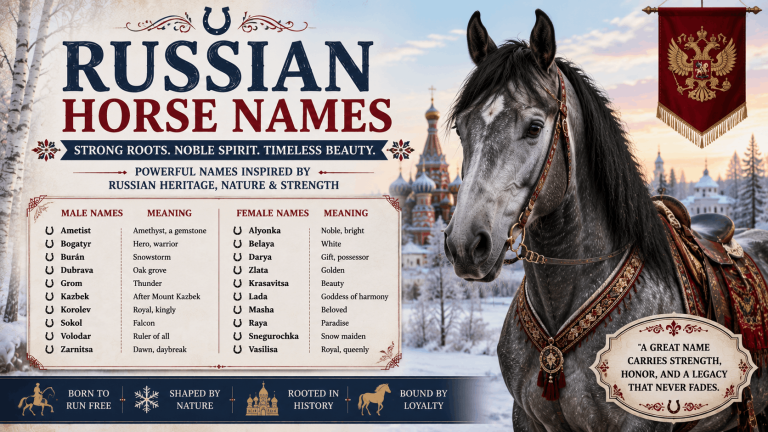
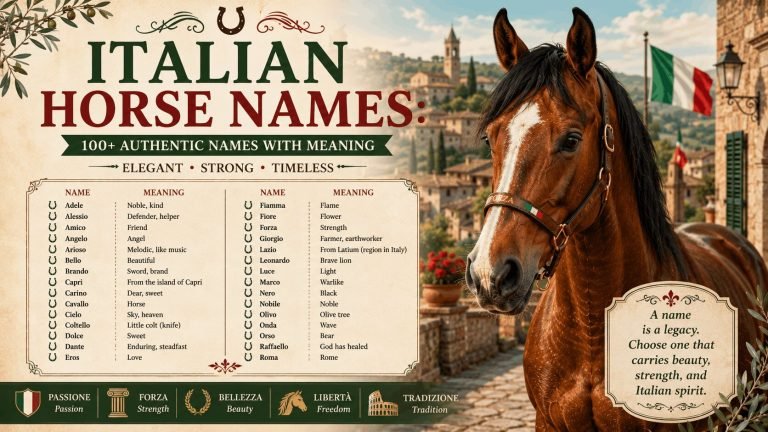
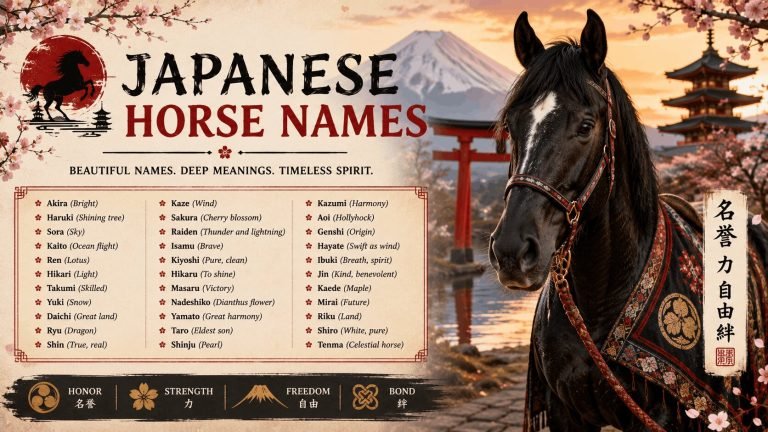
We found these paint and pinto horse names from other languages, such as Spanish, Italian, French, Japanese, and German. Here you will find names with meanings and a short description.
Pintado — Spanish for “painted.” The most direct possible nod to the coat.
Mancha — Spanish for “spot.” Used historically for horses with bold patches.
Bello — Italian for “beautiful.” Simple and true.
Tache — French for “spot.” Understated and refined.
Colore — Italian for “color.” Slightly dramatic, works well for a show mare.
Farasi — Swahili for “horse.” Grounded and distinctive.
Keiro — Japanese for “color.” Clean, easy to say, uncommon in Western barns.
Farbig — German for “colorful.” Bold and direct.
Mzuri — Swahili for “beautiful.” Warm and genuine.
Pinto — Portuguese and Spanish for “painted.” Classic across breed communities.
Funny Paint Horse Names
10 names that are honest about what a paint horse actually looks like.
Fifty Shades of Spots — someone at the barn will get it immediately.
Spilled the Paint — the most literal coat description possible.
Not a Dalmatian — because someone will say it first anyway.
Accidentally Abstract — for the horse whose markings look completely unplanned.
Jackson Pollock — splatter-paint artist. The comparison writes itself.
Tie Dye — some tobiano coats genuinely look like a craft fair project.
Oops All Colors — embraces the chaos of a loud paint pattern.
Inkjet — throws color in unpredictable directions.
Walking Splatter — a moving piece of abstract art.
Technicolor — vivid, over-saturated, impossible to miss.
Two-Word Paint Horse Names
Short compound names work well for horses who need a barn name and a show name that feel connected.
Wild Paint — open and free. Works in Western pleasure and trail.
Storm Patch — weather and pattern in two punchy words.
Painted Sky — the horizon at dusk, layered with color.
Ghost Patch — a pale marking on a dark base. Quiet and striking.
Prairie Paint — wide open and grounded. Built for ranch use.
Color Drift — slow movement of color across a surface.
Shadow Spot — dark tones with a scattered marking.
Spotted Thunder — power and pattern in one image.
Dusty Pinto — earthy, Western, and real.
At the 60% mark of building this list, one thing became clear that most naming articles completely skip: the horses that get called by their name most consistently, in the arena, on the trail, in the barn aisle, are the ones with names that sound distinct from every other name in the barn. Not just unique on paper. Distinct out loud. That is a different standard, and it changes which names make the final cut.
Native American-Inspired Paint Horse Names
Paint horses carry deep cultural significance in Plains Native American history, particularly among the Lakota and Comanche peoples, where painted horses held ceremonial and warrior roles. These names honor that connection.
Chayton — Lakota for “falcon.” Swift and sharp.
Tokala — Lakota for “fox.” Clever and fast.
Kohana — Sioux for “swift.” Fits a quick, athletic horse.
Winona — Dakota for “firstborn daughter.” Graceful and traditional.
Kaya — Nez Perce origin. Steady and strong.
Tala — Native American for “wolf.” Wild and independent.
Dyami — Native American for “eagle.” Powerful and free.
Hiamovi — Cheyenne for “high chief.” Built for a dominant horse.
Hanska — Lakota for “tall.” Fitting for a large-framed paint.
Sunkawakan — Lakota for “horse,” the sacred animal of the plains. Significant as a show name.
Tips for Naming Paint Horses
Match the name to the coat pattern, not just the color
A tobiano with clean, rounded patches reads differently than a frame overo with ragged edges and dark surround. Look at the pattern first. The right name usually follows from that.
One or two syllables for daily use
If you love a longer registered name, build a short barn version immediately. “Painted Warrior” becomes “Warrior.” “Jackson Pollock” becomes “Jackson.” Your farrier, vet, and trainer will thank you.
If your paint has bold, symmetrical tobiano markings, names like Domino, Mosaic, or Patchwork King reflect that precision. If the coat is irregular, scattered, and overo-style, names like Inkblot, Cipher, or Splatter reflect that energy instead. Matching the name to the pattern type is the single most useful filter on this list.
Say the name out loud ten times before deciding
Not in your head. Out loud, across a distance, when you’re tired. If it holds up, use it. If it sounds awkward at volume, go back to the list.
Check for barn conflicts
If you already have a Scout, adding Scouter or Scottie creates real confusion in emergencies. Distinct first sounds matter more than distinct spellings.
Avoid trend-based names if you can
A name tied to a specific pop culture moment works at the barn for two years and feels dated for the next 25. Names rooted in the coat, in color, or in genuine cultural history hold up across the horse’s full life.
Conclusion
A paint horse name that lasts is one that fits the coat, works out loud, and means something to you every time you say it, not just on the day you chose it. Generic lists fail because they are disconnected from the actual horse. The best name on any list is the one that makes you think of your specific horse the moment you hear it.
The APHA registers horses with a wide range of names, from one-syllable barn names to multi-word show titles. Both work. The only name that does not work is one you chose fast from a random list without thinking about what your paint actually looks like standing in front of you.
Pick one that fits the coat. Say it ten times. If it still feels right, you’re done.
FAQs
Paint horse refers to a registered breed through the APHA with specific bloodline requirements. Pinto describes a coat color pattern — any horse with tobiano or overo markings qualifies visually, but without Quarter Horse, Thoroughbred, or Paint bloodlines, it cannot be APHA registered. A pinto can look identical to a paint horse but belong to an entirely different breed.
Based on APHA registration records and Western show programs, the most consistently used names include Patches, Maverick, Painted Lady, Scout, Ranger, and Blaze. These dominate because they are short, pattern-specific, and carry genuine Western cultural roots that hold up across disciplines.
Yes. Solid-colored offspring from two registered paint parents can still qualify for APHA registration as “breeding stock paints.” They carry the paint genetics without the visible pattern. Naming a solid paint the same way you’d name a patterned one is completely valid — the bloodline matters more than the coat color for registration purposes.
Tobiano is the most common pattern in APHA-registered horses. It produces rounded, regular white patches that typically cross the topline. Overo is less common and produces irregular, scattered patches that rarely cross the back. Tovero combines elements of both and tends to produce the most visually dramatic coats.
The APHA allows registered names up to 20 characters including spaces. Names cannot duplicate an existing registered name exactly, and certain terms are restricted. Most owners register a formal name and use a shorter barn name daily — both are worth choosing carefully since the registered name follows the horse permanently in breed records.
About Me
I’m Daniel Carter, an equine researcher and horse-naming specialist at newHorseNames.com. I focus on creating meaningful and authentic horse names using trusted equine resources, breeder records, and expert insights. My research covers horse bloodlines, behavior, and naming traditions to ensure each name reflects true identity and purpose. Through accurate, well-researched content, I aim to help horse owners and breeders find distinctive and reliable names they can trust.